Powered By Blogger

Monday, 12 November 2018

olive edis

Olive Edis

I started off looking into War Photographers and came across the name of Olive Edis. Researching more I learned that she was more than just a War Photographer who in 1918, was commissioned by the Imperial War Museum to photograph a women’s war role/work in Europe. (manly France and Belgium 1918)
This made her the first British woman to be commissioned as an official war artist, and only the 5th official photographer to visit Europe to cover WW1.

Many of these photographs, would have been taken using a large glass-plate camera. These camera's would have been heavy to transport and the negatives delicate.


I find these images beautiful in the sense of the detail and light. I like the fact that a moment in time is captured and how we can learn different things about the images. The clothes and fashion the technology or lack of. The hospital beds being so close together and the conditions the soldiers or wounded had to endure etc. I wonder how long it took Edis to decide the correct composition to get the best outcome. How well did she get to know the people in the images and if they were happy enough to be photographed?  

I believe she also kept a diary or her travels. While detailing accounts of the journey and the effect of war she recorded the beginnings of the post-war reconstruction. As well as the help being given to the large numbers of desperate, displaced people.
At this time being a female photographer would have been rare, not to mention one travelling around Europe detailing the account of war.
 This trip clearly illustrates the changes in the role of women in British society that occurred as a result of the war. 


If however, you look at another man photographer who worked in the same time frame, you'll find a different picture of war altogether

Ernest Brooks,  (Lieutenant)

First Offical Officer and probably the best known. Brooks was known to sometimes set up scenes of the men in action, but also took images during the action. Many of his images did have to be censored.  Quote "His work was noted as being characterised by a "conscious seeking after a publishable photograph",

 A man on the front line and one with nerve nevertheless. His work of the silhouette scene became famous. The scenes that show soldiers walking along a ridge against the light were used to highlight the unknown individual soldiers of the war. I feel this works to illustrate the anonymous heroes of the war. Appropriate really looking back for a historical point of  view.


From these two artist's alone you can see the different conditions the male and female photographers lived. The woman I feel was more protected and safe zoned. 


The Daily Mirror paper, did try to set up a newspaper months before this war.  The paper was to be images for women by women. A radical and costly gamble that then left the paper in financial losses. 

Do you think the editor thought that women being home carers or illiterate needed a paper that gave a basic understanding of the world, from a womens point of view? Or did/would it just fill it with the selling items of the day for the home.

 Propaganda images also maybe, to help shout the cause on every level. Men, women and children and get support from backgrounds of everyone's level.. either way a change in women's role and priority thinking.


After the fall in sales the papers editor Alfred Harmsworth did realise the importance and popularity of the pictorial journal - and so this became the first photographic daily paper. The kind of paper were used to reading today .


More facts about Olive Edis from https://en.wikipedia.org/wiki/Olive_Edis
  •  took up photography in 1900, after being given her first camera in 1900 by her cousin Caroline 

  •      successful business woman who, throughout her career, owned several studios in London and East Anglia

  • one of the first women to adopt the autochrome process professionally

  • was commissioned to create advertising photographs for the Canadian Pacific Railway and her autochromes of this trip to Canada are believed to be some of the earliest colour photographs of that country.

  • if she felt one side of the photograph was too dark she would paint the negative with pigment to make it lighter

  • Edis photographed many influential figures of early 20th century society

  • first women to be accepted as a Fellow of the Royal Photographic Society


https://www.iwm.org.uk/collections/item/object/205194690
https://www.cbsnews.com/news/photographys-era-of-glass-plate-negatives/
https://oliveedisproject.wordpress.com/about-olive-edis/
http://ww1photos.mirror.co.uk/
https://en.wikipedia.org/wiki/Ernest_Brooks_(photographer)
ernest brooks war photographer- google images


betty woodman pottery and thoughts

Beginning her career in the 1950's Woodman is known as a production potter. Her work is best known for it vibrant colour palette and painterly style. 

Below her pillow pitcher's are a great source of inspiration to me. The shape and handles more so than the colours used. After trying out clay for the first time I really relate to the cylinder form being pushed together. With the spouts and handles added also. My own work I think has a similar feel. For me the body and the bringing together parts to form another body or a piece is something that feels natural to me. Like the cells and nature of life itself. 


I read the inspirational work of Oribe pottery (style of Japanese pottery that first appeared in the sixteenth century), Tang Dynasty Pottery were a source of inspiration to Woodman.The painter and artist's like Matisse, Picasso and Bonnard too.. I get a sense of real play and love of the medium from her work. Her work really does bring out a painterly form and I like how expressive it is. The lines and glazes seem to bring alive the pieces.


Other works


My works so far.... 


 I was trying to understand how the clay worked and felt rather than a finished design...


Sources of info :
 https://en.wikipedia.org/wiki/Oribe_ware
https://www.theguardian.com/artanddesign/2018/jan/17/betty-woodman-obituary


Friday, 7 September 2018

art in context - the figure and body in art


Well as a class we talked and looked over a power point about the figure and body in art.

Some of the questions asked : Why do artist's make images of themselves and others?

Thinking back to the cave painting of hands. way back in the caves of  Lascaux - France. Why did the people or artist's feel the need to create such works? For pleasure or outta boredom? To show their worth, in honor of the people and culture, or to ask for more of these images in real life? To pray and ask the gods for more?


I guess we will never truly know and while many theories have been written, I like to think that the compulsion to create is and always has been part of man. I'm not studying art and design for the money, but to satisfy something I had always felt was missing inside me.

Question is will I ever feel I've learned or have enough knowledge? I hope not, I'd like to think that in this day and age, (internet resources, new technologies,  ones own opinions etc) that I will always want to learn and better my own self worth.


Self-worth - How has society and cultures impacted on how we see the body/figures?


Throughout the Baroque era, artwork became full of strong colour, movement, drama and theatricality, through the work of masters such as Caravaggio, Bernini and Rubens, the style became popular across much of Europe.  The Flemish painter Rubens won many commissions from the Catholic church during the reformation.

The females he painted were of a larger size. This is thought to represent wealth, health and  prosperity as the general population struggled with food shortages and famine.  Beauty was all about the Rubenesque figure. Big is beautiful. But not in the way we see it today, the truth being that many painters in his day did draw and paint from the ideals of the Greek and Roman sculptures or the in the style of the perfect figure (male/female). Rubens being religious wanted to capture real people and the anatomy, when god chose between the saved and the damned the fact of who was fat or thin for Rubens didn't matter. It was what was inside that was judged.  He was far more concerned with questions of faith and eternity.


ruben venus at the mirror

Venus and Adonis rubens

The fertility of the earth Jakob Jordaens 


Lucas Cranach the Elder cupid complaning to venus


Being 35 I feel very strongly that my own ideal of the perfect figure has been sculptured in my upbringing! For years and before social media I grew up in a small town and think that many felt the need to conform to the same thinking as many of the other people my age or older. In my younger years nobody gave the younger generation a voice and I feel I went along with the social conditioning and played/ behaved according to what was socially acceptable or the conventions or standards. For years I guess women's figures have been changing, thinking back to the fashion of the 1920's and the flat dresses and slim line shape, to the 1980's when aerobics was great exercise for the body conscious and big everything else.

1920's fashion

1920's fashion

1980's

1980s

1980s

1980s

In class I felt the younger students seemed more confident within themselves, more sure of the facts of what each one believed. Having they own voice and open to debate. I felt two things during this conversation, 1 - jealously of them knowing what they thought and believing whole heartily in what they were discussing.  2 are they naive -  the standards of the past will always come back into place, this everyone has a voice etc is just another farce that lets people think that they opinion matters or that things are changing? Hell things haven't changed for years!

Elizabeth Zvonar - collage artist


People wanting more like in the cave painting of the horse's and buffalo in France, if they were asking for more than they needed? Once they got more of what they wanted do you think the people would have been happier? Or would they have just began to take everything for granted and moved on to more challenging game or resources? Are we ever happy?

Diet and the perfect figure - In different countries the ideal women differs from country to country. What does make someone beautiful?

Renoir 
Asking my teenagers this question of what makes someone beautiful the was interesting, one described the women of being - slim model like with bobbed red hair (not ginger) freckles and a gap in the front teeth! Reminded me of the Renoir image above.

But put in a search for red hair women with gap teeth and this image is what comes up!  happiness lives here I think. picturesque background smiling with red hair and freckles.


 The other (boy) said curvy shape but not too big, blue eyes and wasnt sure if hair colour mattered as it was a personal preference!

My neighbour (female 50+) thinks that the singer/artist Pink is the ultimate ideal of a women. her so called girl crush.

pink

pink


well that's most of us buggered and you'll understand this if you've been to a swimming pool full of families lately! truth is Rubenesque is what I would describe most females nowadays.

joan semmel


When I was the stereotypical perfect slim size, I still wasn't happy! don't get me wrong I was happier fitting perfectly in to any garment I liked, but mentally I wasn't truly happy and still could find faults. Comparing myself with others and wishing something was different. Its tough being human! Men have these stereotypes to live up to also, and this something that comes from the past. Not to show emotion and to MANage mental health alone for fear of judgement. Romans and strong men going to war, tough and hard working men supporting families etc. The David of this time.


Remembering my aunt dying in the hospital bed non of that matters, and yet after realising this my mind still goes back to its conditioned way of viewing the world we live in. Very sad really!
Truth is I prefer to draw a fuller figure over a hinner odel. I enjoy the curves and the mapping of the areas. Yet to be able to see the beauty in myself I struggle.

For me this is the closest the artist's old and comtemporary have came to capturing my idea of beauty


joan semmel

Diego Velazquez


Is beauty only skin deep? Maybe rubens faith and views were correct after all..  I'm not sure I've addressed these questions correctly or spoke enough about the art in general enough... but it has been a starting point for my studies and more questions to address down the line.. I also feel I didn't address the male side of this argument...next I will look at male drawing females and vice versa.


Sources

https://en.wikipedia.org/wiki/Counter-Reformation
Google - Michelago's David - images
http://www.visual-arts-cork.com/antiquity/greek-sculpture.htm
https://sites.google.com/a/pvlearners.net/role-of-women/products-services
https://aplus.com/a/history-female-beauty-standards?no_monetization=true
https://en.wikipedia.org/wiki/Feminine_beauty_ideal
https://pixabay.com/en/portrait-face-woman-caucasian-1580290/
https://www.artspace.com/elizabeth-zvonar/french-fantasy
https://useum.org/artwork/Cupid-complaining-to-Venus-Lucas-Cranach-the-Elder
joan semmel - google search

Wednesday, 27 June 2018

Digital artists and art I looked at (art in coxtext)

The first use of the term digital art was in the early 1980s when computer engineers devised a paint program which was used by the pioneering digital artist Harold Cohen. While the actually digital collaborations were much early in the 1960's.

 AARON was the robotic machine designed to make large drawings on sheets of paper placed on the floor.

                                                                                  Harold Cohen


Worked to produce art autonomously with a computer artificial intelligence. The digital art world has taken off so much since then..


 In the 1990s, thanks to improvements in digital technology, it was possible to download video onto computers, allowing artists to manipulate the images they had filmed with a video camera. 

Here is an example I creted using light to draw 


Robert Rauschenberg

American painter and graphic artist whose early works anticipated the pop art movement.   Rauschenberg worked along side engineers and artist's to produce a work in the 1960's, 

9 Evenings: Theatre and Engineering was a series of performances from October 13–23, 1966


Once the tennis players hit the ball a sound wave was produced and the room work go dark, in this darkness a flash lighting would also be produced. This dimming effect happened each time a racquet hit a ball, conferred on the player’s actions a function bound up with a complex technological system. 

Afterwards this collaboration came together and began to bring together works that helped explore the separation of the individual from technological change. Know as E.A.T (Experiments in Art and Technology) 


The works used video projection, wireless sound transmission, and Doppler sonar had never been seen in the art of the 1960s.

My own looking at light and projection 


Frieder Nake 

Artist and Mathematician


Hommage à Paul Klee 13/9/65 Nr.2 (1965)

For this piece, Nake created an algorithm that instructed the computer to plot a series of shapes in order to produce a work of art. He programmed in the fundamental facts that would allow the computer to start drawing, and then placed in the algorithm containing random elements, which would allow the computer to take over and manipulate the outcome. In doing this, Nake demonstrated how logic and technology could be used to produce a work of art whose appearance was based on chance. 


 Kenneth C. Knowlton

  a computer graphics specialist, artist, mosaicist, and portraitist who worked at the seminal research and scientific development company Bell Labs in the 1960s alongside EAT founder Billy Kluver. 

While developing work with other colleagues. Knowlton produce an image which would be known as 


Young Nude


by scanning a photograph, then converting it into a pixelated, half tone image. This work produced an photomosaic which was revolutionary.


Nam June Paik

Good Morning, Mr. Orwell (1984)

questioning the role of television in society,  Paik coordinated a cast of actors, musicians, and artists and added his own graphics to produce a live compilation, which was viewed by 25 million people. 

Image result for Nam June Paik Good Morning, Mr. Orwell (1984)

Image result for Nam June Paik Good Morning, Mr. Orwell (1984)

Paik's video piece was important because it used one of the largest stages in the world (television) to posit that digital technology could fundamentally change the way art was made, distributed, and viewed.

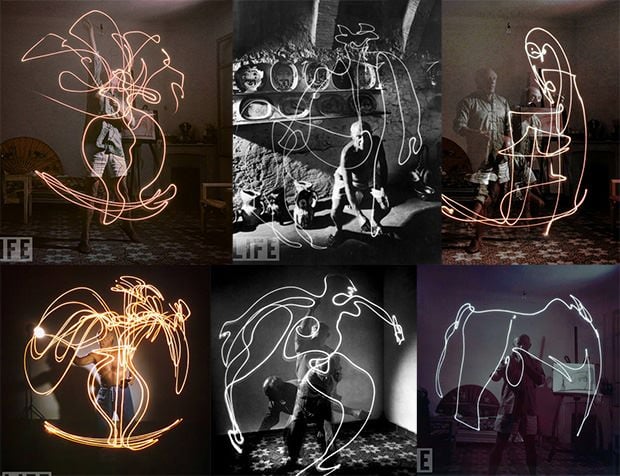
Picasso painting with light was another thing that comes to mind with regards to using a camera to capture slowed down photography (shutter speed etc)
Image result for picasso painting with light


My working example