Powered By Blogger

Wednesday, 21 September 2016

Mary Morrison


Image result for mary morrison artist


Edinburgh uni/college of art joint degree
Student exchange France 1989 
Edinburgh College of Art post grad Diploma

Mary Morrison who is now based in the Scottish Borders grew up in the Western Isles (Isle of Harris) She works mostly oil on canvas and her theme includes the landscape, location, mapping, grid references, tide tables, music and poetry. Her works are mainly referencing the western isles and her intention is to explore the light and space reflected in the islands.

She is inspired by  artists/poets like Kenneth White (rumi), Iain Cricton Smith (lewis), John Cage, Anish Kapoor, Mark Rothko, Shirazeh Horushiary and Anges Martin.

Image result for Shirazeh Houshiary
Shirazeh
Image result for agnes martin grid
Anges martin
Image result for mark rothko prints     

Image result for mary morrison artist
example of morrisons work

While Morrison has another job and only does art part-time she did stress that the WASPS workshop she rents for studio space had a massive push, motivation and inspiration on her creative mind set. Being close to other artists was of great benefit for her.

She tends to work on a flat as the mediums she mixes can be messy and need time to dry and blend. Her works can be added to or reworked. She did take references from the Gaelic language ad talked about some of the poetry and the words she had liked and used.... FONN- meaning land music and state of mind.

We talked about the internet and how modern times have made life easier for buyers and sellers to notice your work. She had told us that its not always at an exhibition people tend to buy works, but sometimes after the exhibition itself. 


Not everyone can connect to a work but I feel learning the reasoing behind a work gave it more understanding or meaning.

Overall her talk was a very interesting way of hearing an artist's connection with her work. The work itself is kind of abstract and has interesting mixes, some opaque and some translucent..... Her gribs and barcoding and tide tables add another interest point next to the colour palette. 

Image result for mary morrison artist    Image result for mary morrison artist
Image result for mary morrison artist Image result for mary morrison artist


WASPS = Workshop, Artist, Studio, Provisions Scotland.

Image result for mary morrison artist
wasps work area
Profile_mary_morrison
mary morrison


Biography and personal note

 I am an artist based in the Scottish Borders. I share a studio in an old textile mill with 12 other artists. I also work part time for Live Borders managing the Creative Arts Business Network (CABN) which supports professional creatives and organisations in the region. We provide advice and support, run events and develop opportunities for artists of all artforms including local and international residencies and creative labs.

Romanticism


Romanticism (1700-1860)

Romanticism was more about how one feels about a state or observation. It became a way of expressing distaste of the political world, church or of the powerful.This occurred mainly after the French Revolution and also the period known as enlightenment. It didn't really take off however, till the early 1800's -1850's. While the ‘Romantics’ would not have used the term themselves: the label was applied from around the middle of the 19th century.

The biggest association to the movement I've found seems to be poetry. Some big names like William Wordsworth, Rosseau and William Blake for instance.

George Gordon Byron was born on January 22nd 1788. Lord Byron was an English poet who was a leading figure in the Romantic Movement.

Image result for english woodland


“There is a pleasure in the pathless woods;          
There is a rapture on the lonely shore;
There is society, where none intrudes,
By the deep sea, and music in its roars:
I love not man the less, but Nature more…”


In 1762 Jean-Jacques Rousseau declared in The Social Contract: ‘Man is born free, and everywhere he is in chains.’

William Wordsworth's As I wander is a good example of the dreamy and descriptive way the romantics used words


 I wandered lonely as a cloud
That floats on high o'er vales and hills,
When all at once I saw a crowd,
A host, of golden daffodils;
Beside the lake, beneath the trees,
Fluttering and dancing in the breeze.

Continuous as the stars that shine
And twinkle on the milky way,
They stretched in never-ending line
Along the margin of a bay:
Ten thousand saw I at a glance,
Tossing their heads in sprightly dance.

The words invite images in your mind and gave way to a new way of thinking and viewing. In truth the romanticism felt they could heal and regenerate mankind spiritually.

Romantics had a strong belief in the senses and emotions, rather than reason and intellect.

English Romantic landscape painting emerged in the works of J.M.W. Turner and John Constable. These artists emphasized transient and dramatic effects of light, atmosphere, and colour to portray a dynamic natural world capable of evoking awe and grandeur.

Snow Storm—Steam-Boat off a Harbour’s Mouth, oil on canvas by J.M.W. Turner, 1842
Théodore Géricault was a painter who exerted a seminal influence on the development of Romantic art in France.

Here in the shipwreck painting he makes a point of bringing up the political implications of home and how the captain got his job so to speak because of the connections he held. The ranks of importance and emerged the overall distaste of this I guess.

“Raft of the Medusa, The”
The Raft of the Medusa, oil on canvas by Théodore Géricault, c. 1819; in the Louvre, Paris. 491 × 716 cm.
The psychiatric studies, and the view on the good vs bad was also up for debate and many used the romantic period as I way of challenging the system. 

These are a set of painting by Géricault, who did a commission for a psychiatrist who wanted to bring to light the fact he believed the insane could not be held responsible for their actions and felt that there should be a ban on executing the mentally ill, supporting instead the idea that they should be confined to an asylum.  Usually an object of ridicule, the images of gericault's portraits invite quiet contemplation, treating their subjects as afflicted with a real illness.

a kleptomaniac
man suffering from delusions of military command
a child snatcher

woman suffering from obsessive jealousy

So we have a thief, jealous women and a guy with PTSD and they'd declared them insane. I wonder what they could make of our society now!

So romanticism included and affected such things as poems, plays. art and nature.

Sunday, 28 August 2016

Morris & Co. - A Revolution in Design

Found this designer William Morris while looking for wallpaper for my home.. Again just another example of how  looking for one thing ends up taking you down another pathway..


 The block printing I can look at for a starting base,  then go on to look into digital printing etc... Maybe look at the differences like pro/cons etc... If I get to use examples later on down the line then great.. But it is very much of interest to me at this time... More the prints and detail...old school style of doing things..


 I have found myself thinking about objects lately, nature  an easy example and trying to imagine a design.... Usually in patterns, abstracts, colours. Asking questions like shape purpose and form... Intention etc what can create design. .. It was in fact the object maybe itself that was someone's design.

The plant while on my last holiday was a fan palm, as I looked at the pattern and texture, colour transparency and size. I could see it as a wallpaper.. The sky blue against the leaves or the white of the clouds against the green together makes a fresh, cooling design.... I sat for ages just looking that these trees..


I came home and looked for wallpaper design of the fan palm. what era I wonder would this fall under.....?? I would be interested to learn!!


New technologies have also grabbed my attention because of the capabilities and methods used today! Id be a fool to dismiss them while still keeping a keen interest on my traditional enthusiasm of design.

A must watch


Note to self to look at orwell and goode again!

Letterpress Printing Smails

Smail's Printing Works 

Innerleithen
Image result for smail's printing works


Today I dragged my mother along to Smail's printing works, and I have to say she rather enjoyed herself. As we entered the shop we were greeted by two friendly faces. Looking around the abundance and high quality of this aged old style of printing was everywhere, from cards and posters to stamps and calendars, art works etc. What stood out to me was just how neat and bright the finish result could be. The black ink was so (what can I say...but ....mmm black) and the yellows and reds just jumped right out. Precise, neat and clear, yet with a sense of ownership and importance you couldn't help but sense something special was awaiting us.

The basic and easiest way to understand the principle of letterpress is to make a fingerprint, Ink is carried on the raised (relief) area's of the finger pad.  The paper then comes in contact with the raised areas and so the print or impression is made.
Like many good ideas the printing press evolved from WINE..... yes we've all had a good idea or what we consider at the time a good idea while the red/white stuff is flowing. Johann Gutenberg (1400-68) a German metalsmith invented a printing press from the same basic principles of a wine press. This revolutionised the printing process.

While some of the technical terms do go way over my head, in the same way you have to see art in the flesh to really appreciate it, a visit to a print workshop like this is definitely worth a visit. The time and careful processes that go into this (which I can consider in its self a art form now) are truly something to be remembered. The National Trust for Scotland took over the family business in 1986 and its no wonder why.

Image result for smail's printing works


The staff were very polite and the way you were guided along the museum was fun and interactive. The sheer size of the machines and the noise that must of came from working in an environment like this must of been intense. Apprenticeship's alone lasted as long 7 years and for this reason a printing job was consider for life. From mixing the inks to fetching the types he would learn all aspects of the business.

Business was strict too.. long hours were typically  Mon-Fri 8 til 6 inclusive, Saturdays 8am til noon inclusive.


As stated in the apprentice card from smail's  (part of the interactive experience)

Minimum hours to be worked are to be NO LESS than 54 total hours in any given week. It is expected that all Apprentices shall volunteer extra hours to meet exacting deadlines for the good of the business ( it is with reading these words that I question when it all when wrong, jesus now the staff own when they work and dictate to the owners) Execptions to this will be made on saturdays for any apprentice called to represent the town on the Rugby or Football field during the season.

Holidays - 25th December : half day  1st and 2nd January at Mr Smails discrection.....

Compositors - set the type for the all print jobs. These were educate men and were capable of turning the customers scribbled words into visually pleasing and readable designs. 

I also noticed the way we read and write has changed considerably over the years, looking at the old guardbooks and some newspaper prints it was very clear the difference and manner in which we read and talk now is so different. Some of the sentences to me seem more like poems. Grammar not being a strong point with me haha I wouldn't of made a good compositor.

Image result for smail's printing works
one of the 52 guardbooks


 Printers - mechanically minded and physical strength and stamina needed. good hand eye coordation with impeccable attention to detail.

Image result for smail's printing works Image result for smail's printing works

The shop is still using the old traditional machines for private commissions as well as the souvenirs for sale in the gift shop. It also has working examples of the water wheel, paper room and office.


What I did enjoy and find interesting was the fact that some of the well known saying came from this industry....

DAB HAND - before rollers printers used dabbers to dab ink onto the forme before each print was taken. It was critical that an even, thin spread of ink was applied to ensure consistent impressions for a job, and thus those who could do this well were consider a dab hand.

MIND YOUR Ps AND Qs - easy to confuse the mirror image ofthe p and q type, meaning for the apprentices to be careful when helping thecompositors. While nowadays it more a term used for manners it did originate from this.

OUT OF SORTS - Sorts are the individual pieces of letter type. Should a compositor runout of a certain letter in the middle of a setting job, they would be displeased.

and many more.....

Overall definitely worth a visit for young and old.  Will buy some special occasion cards from here and visit again when I have more questions and need answers......


Image result for smail's printing works Image result for smail's printing works

Image result for smail's printing works 

This also reminded me of the art nouveau poster prints
Image result for Art Nouveau poster  Image result for Art Nouveau poster

or the old western wanted posters

Image result for american western posters       Image result for american western posters    Image result for american western posters


Wednesday, 10 August 2016

The Summer Show, The Gallery Tweeddale Museum

Upon entering the room you couldn't help but be drawn to the colours and mix of bright pastels and ink black stokes upon them...

While different artist's on display the works themselves while similar on first glance, became a mix of artist's with they own unique style.

First up was Lida Hatrick and I did notice her soft pink and orange palette. warm and soft but with movement and energy.

Next my very own lecturer Niall Campbell, (careful what I say here haha) But in honestly I did see his own style coming through, while I haven't witnessed much of his work, I could see the characteristics and when I looked around the room I could easily identify which works could be his!

He seemed to have sets of 3 images together using the same colours on each canvas. The colours were strong but muted and gave the feel of past, authority or enforcement. The works had a less linear feel to them and circles were a prominent feature in them. the circles gave a softer but bold yet submissive feel......with the warmth from the prints themselves adding yet another sense. An interesting mix.

Which asks a few questions in itself, especially for a student who is just trying to learn and discover they own interests....

1 - Having your own style! is it a good or bad thing? Is it like a signature in itself?

2 - How important is it to have your own style?

3 - Does the medium you use change your style?

4 - Is it important to be able to identify an artist from first glance?

In truth I haven't been around long enough or have taken the time out enough to know the answer to these questions. If you think about the master's, everyone who's a real arty can identify the works of a van gogh or a turner. Now we have high tech methods like image data acquisition technology. But for the everyday artist, how important is it?

 Are the everyday artist's of today making history. Is the artist giving a time period, whether it’s abstract and modern or traditional. The medium itself used?Will that in time define a period or trend? The internet!!! how we buy sell and create art.

With one of Niall's work I could see it as a cushion! I think it was called a sense of place.......now without knowing anything about why or what it was about, did Niall intent for it for the purpose of homely, living, style of work? Was a sense of place fact or questioning! Did it even exist!

How important is the Title of a Work?

Three (21,22,23) had the same print imagery on the canvasses and I did wonder if it was something more opportunistic like he'd liked the way the print had turned out and thought I'll do another....or if he always had three/four/five works at a time on the go every time.

From everything I see I can't help but feel, I'm missing the biggest thing for my art studies and that actually doing......I can easily sit and type my thoughts yet what I need to do is to try! Shit where and what is time and how do I get some?

The work of Line Mortensen was a different way of me viewing. Using Italian smalti glass, gold leafed tiles, glass rods and recycled slate the artist made a type of wall art. At first I was dismissive of it, thinking -  could of at least made it into a mirror for that price! (my bad) but after leaving the gallery I can appreciate the amount of time and work that most of when into it. From selecting the size, shape then set up to cutting, placing and creating the work. Thats without asking the intended purpose or story behind it.......

Mixed media on canvas seems to be the in thing the now and this puts me off wanting to learn more because I feel I want to create something unique to me.

I guess my first thing I'd want/need to do is my colours.. to mix and create a colour. From a few select colours, (primary etc) to learn my colour wheel basics again and refresh my mind with the mixing process.. To challenge myself to be able to get my intended colour. making the exact intend colours.

TO BLOODY DO SOMETHING CREATIVE INSTEAD OF JUST ASKING QUESTIONS!

Old Gala House, Alfons Bytautas exhibition


Alfons Bytautas.
Incantation Exhibition @ Old Gala House


A Time to Keep Silence
acrylic and collage on canvas

Picture


Oh the irony!!    Upon entering the exhibition at Old Gala House with my daughter (13 yrs) and son (2 yrs) I should of knew I was in for a somewhat challenged time. Within 3 mins of walking into the white square room lined with the works by Bytautas, my sons curious nature and attention had quickly disperse to his free rein of marching up and down the room singing the elephant march song from Disneys The Jungle Book.......

Bad idea bringing him along I thought as I tried to ssh him and scan over the works.

A Time to Keep Silence ......mmm indeed....I couldn't help but smile and take comfort from my predicament and the inappropriate title I looked upon then. My time here was quick but the one thing I did take from my visit was the importance of colour and line.   Why colour and line?

It can guide the eyes and evoke a feeling. The intense colours and they selection is something to be appreciated.

The collage mix I also found interesting. I have been interested in mixed media for the past year as it seems to stir something inside me....Maybe because I have an active busy mind I can sense the fun and childlike excitement that could create such works.

Since coming home and doing a little research into Alfons Bytautas I have learned he was a local boy,  born in Selkirk (1955).

He studied painting at Edinburgh College of Art, where he first began to develop his life-long interest in the technique of etching. Then working in an Edinburgh print makers for 30 years as a Master Printer and Senior Etching Technician.
Bytautas became know as a pioneer in the world of printing after help develop the acrylic resist etching and photopolymer techniques...........

I think from what I found it was kinda like the water-based non - toxic alternative from the more old oil based paints us decorators would of used, just in an ink art term... If anything like the painters alternative it will have its pros and cons.........Health and Safety being the biggest (pro) ..Environmentally as well as on the artist and people using it. Next the in colleges, schools and workplaces! Colours and mixers you can create may have expanded, plus surfaces etc..The ability to over-paint quickly, work in layers that differ in terms of opacity, transparency or viscosity. However, if you tend to be a bit old school like myself it may not compare to the more traditional stronger mixes.

Anyway I'm waffling and think I will visit the exhibtion again, alone! But if my interest in printing continues this guy seems to be someone to reference.  Some of his works on display included:

Finding Joy

gouache/collage
Back to Nature

Picture

Mirror

gouache


Here's an example of the kinda work that could be adapted and used in advertisement... While I think its a mix of artist's you get the idea..
Northumbria To Light Up London's Art Scene
notice line from and colour
 A guerilla street art mural that brings Northumbria University, Newcastle's student designs to life at Ely's Yard on July 3, 2014 in London, England.

I did like the quote..... As Tom Stoppard wickedly points out  –  “Skill without imagination is craftsmanship and gives us many useful objects such as wickerwork picnic baskets. Imagination without skill gives us modern art.”


Thursday, 21 July 2016

I have a dream... Fabric Wallpaper :)

Fabric Wallpaper (for the masses)

I have for many years now enjoyed my work as a Painter and Decorator however, I also have felt something was missing!

My interests at the moment are on the traditional printing methods on fabrics. In saying this I don't really have a clue about the technical processes behind the production of fabric. I know the basic stuff like cotton, nylon and wool. Wool for instance being from the coat of a sheep or goat and has a number of benefits like the warmth and insulating properties, waterproofing and in days of old was also wind resistant making it a vital commodity for the first traders and hunters. Still used and as popular today the history of wool makes for an interesting read.

One of the earliest memories I have is the story of sleeping beauty spinning a yarn or whatever on the spinning wheel.

 Image result for sleeping beauty spinning wheel

I remember being fascinated at the time with the spinning wheel machine, Wonderment mixed with a little bit fear, unsure of the fact that a small prick from it send sleeping beauty into a deadly sleep......

The spinning wheel also appeared in the film Rumplestiltskin, spinning straw into gold.

The stuff of myths and legends or is it?

The history of the spinning wheel tells of the bible story that also mentions spindles and spinning.  Spider Woman, a Goddess in Navaho culture, taught them the art of spinning.

 Arachne (a spinner) challenged the goddess Minerva to a spinning and weaving contest and was turned into a spider in Greek mythology.
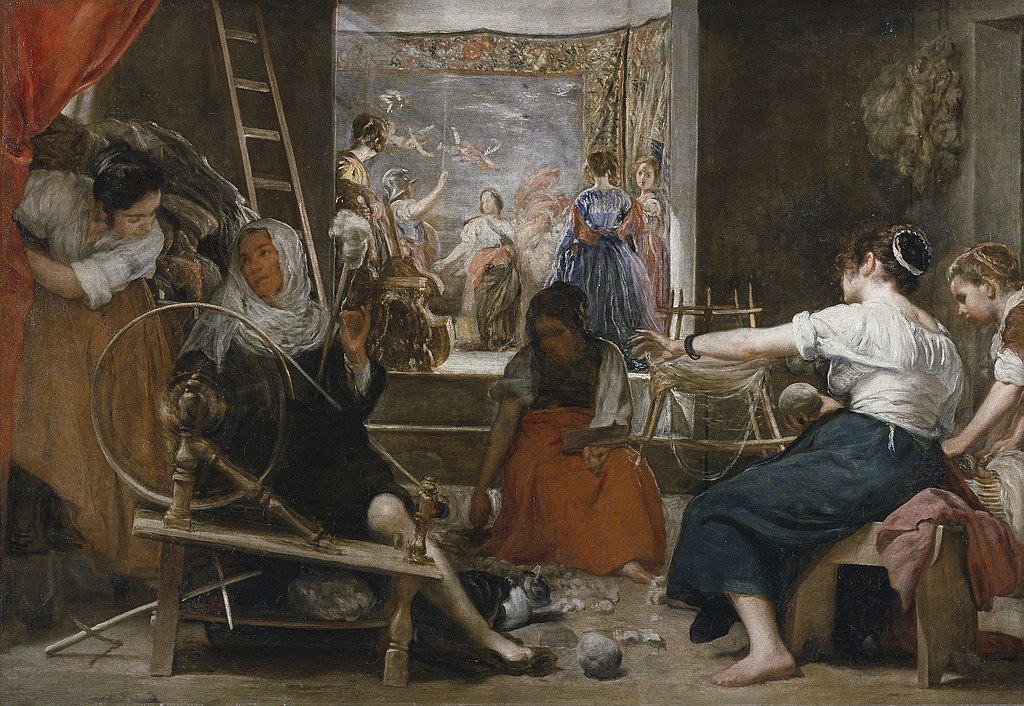


The Spinners, or, The Fable of Arachne (1644–48) by Velázquez

Who is Velázquez

Velázquez was born in 1599 in Seville in southern Spain, at the age of 11 he was an apprentice to  Francisco Pacheco, Seville's most significant artist and art theorist.

Velázquez soon surpassed his master and here I was shocked to find a link to the artist Caravaggio. Caravaggio was famous for his dark, dramatically lit works and un-idealised models.
Image result for the calling of st matthew
Caravaggio the calling of st matthew


 Here I find a connection to the importance of Art History! It seems that the path of art is all interlinked and connected in many ways. Its so easy to lose sight of the intended subject and find yourself immersed and engrossed into a total different subject. From wool production to the greek mythology to the artist Caravaggio. Also the link from Velázquez studying the work Italian paintings (titian) led me to such works of Titian. He then became acquainted with the artist Rubens who was another big name. Fascinating stuff!!

Now how do I get back to my intended subject- Fabric Wallpaper?

In truth I dont really know about the best fabric to be used for the process of making a fabric wallpaper but I know it can be done! I seen it once at a job, a damask pattern hung in a dinning room! It did give a touch of elegance! I think used in the right way this could make way for a fresh modern trend. Having colourful abstract pattern for the younger clients and traditional scenes for the more old style tastes or period homes.

Questions I ask myself are : What about the surfaces, intention and modern technology. Digital printing vs traditional methods.  I don't intent to look at murals etc or vinyl wallpaper. I want a cotton like fabric soft to touch and can be used in bedrooms of dining/living rooms. To incorporate it into the curtains and upholstery as well as the walls. Depending on the clients brief etc.   A real leather wall or leather panels to recreate an wealthy look of the old style gentleman smoking room, mixed with velvet's and rich colours of burgundy reds and browns! Hunting themes in a boot room or fishing theme etc.....soft white fabric with little flower patterns for a ladies bedroom giving it a light roomy feel. Repeat patterns of famous art scenes or culture theme works. China's and Japans art world is something that I have heard has taken a massive boom in the contemporary art world.


Inspiration for the western world is another area I would like to look into..

 The artist and print maker  Hiroshi Yoshida is known as a Western-style painter and printmaker. Born in Kurume, he lived and worked in Tokyo. He first painted landscapes in oil, but won early fame as a watercolorist. He developed an interest in printmaking in 1920 and self-printed all of his work except his first seven prints. His early printwork depicts views of Swiss and American landscapes.

Fond of traveling, Yoshida was also an avid alpinist, with mountains and water figuring prominently in his works. A significant contributor to and organizer of important exhibitions at the Toledo Museum of Art, Yoshida's work was well represented, with 113 prints in the 1930 show and 66 prints in 1936. A romantic realist, Yoshida's style resembles that of an English 19th Century watercolorist applied to Japanese themes.

Hiroshi Yoshida is noted for the subtle colors and naturalistic atmosphere. His works won numerous prizes in Japan and in the world, gaining strong Western influences during his travels. He later established the Japan Alpine Artist Association.

Thumbnail of Original Japanese Woodblock Print by
Yoshida, Hiroshi Thumbnail of Original Japanese Woodblock Print by
Yoshida, Hiroshi some of Yoshida prints from the site castlefinearts.com.....


I could see this as a repeat pattern as a traditional print fabric but bringing out the intense colours


Why fabric when you can used Wallpaper? Why not!! A touch of class. Our homes are an important part of who we are and with our busy lifestyles a made to last personal touch to come home to and enjoy is something I know I would love!

Made to measure and sewn in a factory! Then hung in place. Surely it can be done and on a varied budget.

A small team of workers with skills in joinery, electrics and painers/plasters would quickly workout the easiest and fastest method to work in.

I do need to learn and explore more into the world of textiles and techniques as well as print and block printing. But for now this is a starting point.