Powered By Blogger

Friday, 20 April 2018

Skull and blue bottle test.. (1) final project


Firstly I used filler to outline the shape and high/lower pieces of the skull.. I struggle to add depth and 3d shape to my drawing or paintings and wondered if this would help. Another thing I seem to have noticed is the angle of the final image always seems to slant slightly left that straight. not so much on these works but in past works 


Next I made a view finder thing and really did try and draw the skull as good as possible.


With this done I began to paint. I felt I was just laying up paint over paint and this is something I do a lot. 


Some bits were really working well and I began to seee how the shadows are cast and how the eye works. Overall still not right but it was a starting point.


The bottle one was a total fail from the start, not happy and gave up. By this point I had spend most of my day painting. 


1984 ideas.....

Illstration Ideas for the Orwell book 1984
Thinking of the cover or back of cover

Nineteen Eighty-Four


Nineteen Eighty-Four, often published as 1984, is a dystopian novel published in 1949 by English author George Orwell. The novel is set in Airstrip One, formerly Great Britain, a province of the superstate Oceania, whose residents are victims of perpetual war, omnipresent government surveillance and public manipulation. Oceania's political ideology, euphemistically named English Socialism (shortened to "Ingsoc" in Newspeak, the government's invented language that will replace English or Oldspeak) is enforced by the privileged, elite Inner Party. Via the "Thought Police", the Inner Party persecutes individualism and independent thinking, which are regarded as "thoughtcrimes"

SO 

At the back of the book the novel talks about the example in the declaration of independence

  • All men created equal and are endowned by their creator with certain unalienable right
  • Among the right are Life, Liberty and the pursuit of Happiness
  • Governments are derived and instituted among men
  • If government become destructive, it is the right of the people to to alter and abolish it, and govern a new institute 
From this I decided to to look at the fact that the new language would be fixed from at later date of 2050.

Using the black ink I thought about the old quill and ink that would have maybe be used to write. I was thinking of the word Equal - E quill...... The fact that all men are equal... see where Im going. The red circle I thought about as a warning and kinda full stop, show of importance. However after doing this I felt it looked to much like a Japanese flag.


Arylic red paint and black ink, with roller and lettering. The lettering isnt really one I would have choose, but had to use what was available. I would have of look for something similar to what was used for the declaration or the same typography used in the book itself of the date 1949 when the book was first published... Research needed here! 

Image result for japanese flag
japanese flag


Play on words here - women /men....2050

I was thinking for along my own feminist viewpoint here and quickly realised that I have to keep to script.


Feathers - thinking of an etching and the quill....idea


I actually went out looking on the grass for these feathers, the little I found after few minutes.... on the way back through the college doors on the mat.... an actual bigger feather was there just sitting waiting for me... I thought maybe a sign I'm on the right track. Do you believe in fade? 


Below I was thinking more of black outs and britain in the war...... When the people were ruled and ordered about etc. Since watching the film Ive only looked at a selection of pages and don't I've clicked to well with this topic.


I look forward to seeing an end result and how it actually turns out. Think some computer edits would be handy tool to used with this topic.


Monday, 19 March 2018

contouring a quick look for reference (ptat)

Topographic Map Colors


The color brown is used to denote most contour lines on a map, which are relief features and elevations. Topographic maps use green to denote vegetation such as woods, while blue is used to denote water features like lakes, swamps, rivers, and drainage.

At higher elevations, mountains may be snow-capped year around, or the terrain may actually be a glacier. In each of these cases, contour lines are also drawn in blue. It is therefore possible to quickly discern that a particular route from A to B might be more treacherous than operating at a high altitude—the trek might require crampons, an ice axe, and other materials that might not be readily available once in the backcountry.

Finally, black is used to represent man-made objects, including trails. Red is used for man-made features, like main roads or political boundaries, and purple for new changes or updates on the map that weren’t previously represented.

Ive looked a little into the different styles etc... But I've not got time to fine the actual maps for the areas I walked... or my body contours and heights....is more of a guess.


Rene magritte and other artists - surrealism

Surrealism and symbolism  - Is it connected?

Time - Lines - http://www.surrealismart.org/history/branches-surrealism.html 

As much as I can tell these two movement have indeed similarities.  The Surrealist artist's are said to have been inspired by the rules of Symbolism and the spontaneous abstract style of Max Ernst.


The first style of the surrealist artist were more known as illusionists and wanted to create realistic representations of a sleep state; in their work. The artist's like Dali and Ernst incorporated elements of nature, animals and even human figures.


The artists bypass reason and rationality by accessing their unconscious mind. In practice, these techniques became known as automatism or automatic writing, which allowed artists to forget conscious thought and embrace chance when creating art.

Salvador Dali

automatism by André Masson


Max Ernst - worked around 1909- 1976.... A soldier in World War I, Ernst emerged deeply traumatized and highly critical of western culture. many artist have taken inspiration from Ernst (Pollock -abstract expressionism) and the artist also told the ideas and inspiration of  Sigmund Freuds dream theories  ....... discovering the possibilities of autonomism and dreams;  his artistic investigations were aided by hypnosis and hallucinogenics. For me all these artists and theories play a massive part in the time of all ism's.

'Men Shall Know Nothing of This' 1923


Image result for max ernst

Above the moment of calm reminds me of the work by Anselm Kiefer. While done later on in the 1939, another one of Ernst many styles.


photo-montage


Magritte was a painting philosopher


Magritte spent many years working as a commercial artist, producing advertising and book designs, and this most likely shaped his fine art.


Words and images - la trahison des images, illustrates this setting words against representations, he accompanies a picture of a pipe with the word this is not a pipe!

This was to throw our thoughts up and aback by a true fact that indeed it is not a pipe it is a painting of a pipe, but our response could argue against the imagery and the fact it is a pipe..... however, what Magritte is signifying is the distinction between, which part of the pipe makes it a pipe.... is it the pipe in General, the mouthpiece, the object of such a thing in a gentleman's pocket, a class of an object? In English is it a pipe but in maybe in Italian the image will be matched with a different word... ..... a child maybe won't have seen a pipe but can read the word.... what does this do to their knowledge of they world?

Words are arbitrary, unreliable things, yet we tend to put more trust in them than in images even though we agree that images can approximate to visual facts...


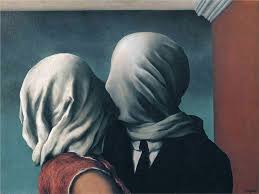
Image result for rene magritte surrealism  Image result for rene magritte surrealism Image result for rene magritte surrealism Image result for rene magritte surrealism

Image result for rene magritte surrealism Image result for rene magritte surrealism

I think Magritte's style is very obvious in the style of colour palette and flatness, and imagery. But the thought and theories are not so clear.  I feel the artist comes across as blunt in these works.

The men in bowler hats that often appear in Magritte's pictures can be interpreted as self-portraits. Portrayals of the artist's wife, Georgette, are also common in his work, as are glimpses of the couple's modest Brussels apartment. Although this might suggest autobiographical content in Magritte's pictures, it more likely points to the commonplace sources of his inspiration. It is as if he believed that we need not look far for the mysterious, since it lurks everywhere in the most conventional of lives. Nothing as queer as folk....

magritte and wife


I do think that many different qualities have gone into these ism's and I think each one could be characterised into lots of styles. It's really down to the time period and conventions in the artist time and life at that moment. Maybe this is just what happens when creative minds get together and influence each other to create big better works.